
Key Biscayne Magazine May 2026
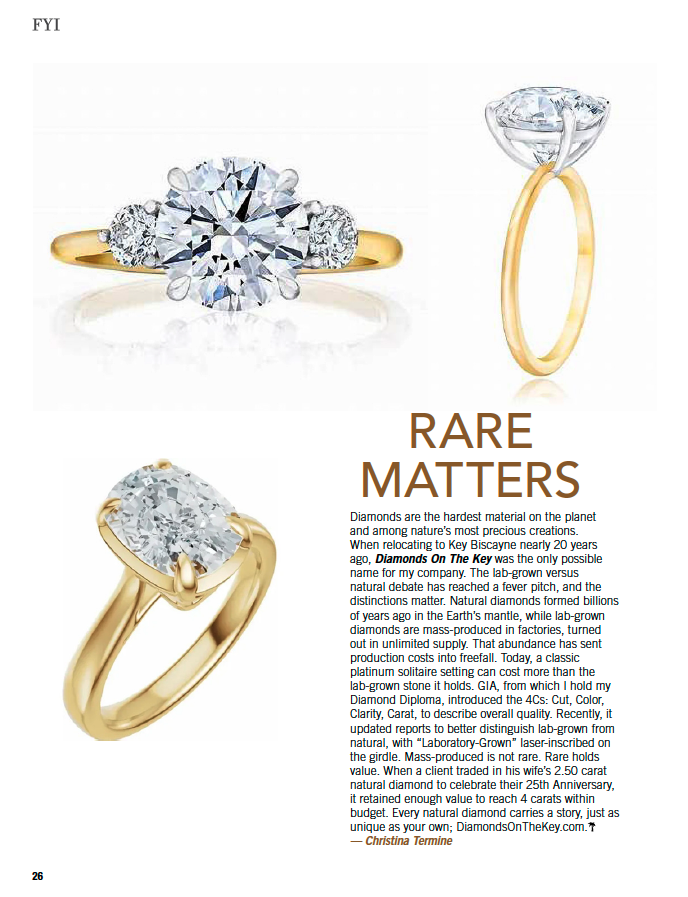
Read full unabridged article Natural Diamonds vs Lab-Grown
Diamonds are among nature’s most precious creations and the hardest material on earth. When relocating to Key Biscayne almost 20 years ago and pondering a name for my new company, “Diamonds On The Key” was the perfect combination. The multiple facets of my 40-year career in fine jewelry enable me to share my professional expertise, insight, and opinions with my clientele.
The growing debate between “lab-grown” versus “natural-mined” diamonds has risen to a fever pitch and here are key factors to keep in mind. The two are NOT the same, even if they may appear identical, with the most significant differences being time, origin, and cost. Natural diamonds were formed billions of years ago in the earth’s mantle, compared to laboratory grown diamonds, which are mass produced in factories, speeding up high pressure and heat within a matter of weeks. An unlimited supply is turned out like baked cookies, which has contributed to their rapidly falling production costs and price. With precious metals continuing to rise, the cost of a classic platinum solitaire setting is significantly more than a one carat lab-diamond it cradles. Compared to a finite quantity of natural diamonds, mined a century ago or today, whose price fluctuates but can retain value depending on quality.
The Gemological Institute of America (GIA), from which I hold my Diamond Diploma, established a descriptive language in the 1940s known as the “4Cs”: Cut, Color, Clarity, and Carat Weight. Adopted worldwide as a universal standard, these combined factors define a diamond’s overall quality. GIA recently introduced visually different grading reports and terminology, to better identify and classify lab-grown diamonds apart from natural diamonds. Structural growth marking and technical instruments assist in differentiating the two, with “Laboratory-Grown” laser inscribed on the diamond’s girdle, along with a quality assessment number. Natural diamonds too are laser inscribed with their identifying report number, which makes purchasing a GIA certified diamond a guarantee of type and quality.
The two products are economically and fundamentally different from many perspectives. Abundantly plentiful and mass produced does not feel special. Rare does. And for someone seeking “value retention” then natural is the way to go, whether selecting a diamond or colored gemstone. Collaborating with a jeweler who respects your budget, to deliver your ideal engagement ring is foremost. Recently, I had a client about to celebrate a 25th wedding anniversary, who wanted to trade-in his wife’s original engagement ring for a larger carat size. Despite the ups & downs of the natural diamond market, the 2.50 carat had “retained value” to help parlay it into a 4.00 carat diamond, while staying on budget. Compared to a young client of mine, who worked hard to save for an engagement ring, only to find that the lab diamond ring his girlfriend desired cost more than double! Despite suggesting natural sapphire or ruby alternatives, she could not be swayed. So, I procure the same quality lab-diamond and custom setting to fit his budget; while making sure he clearly understood this diamond would not increase in value over time. Collaborating with a trusted jeweler to ethically disclose and thoroughly discuss these key differences, while putting the client’s best interest and hard-earned budget first, is paramount.
While “heirloom” is a term often used for antique cut diamonds, the misconception that a lab-grown diamond cannot be handed down, nor considered an heirloom in the traditional sense is untrue, to which I say “the symbolism, love, and journey of any diamond becomes its own story and is unique and precious to each recipient”.
Christina Termine, Owner-Diamonds On The Key
diamondsonthekey.com
305-851-1460
Key Biscayne Magazine May 2026
Link below to the complete digital magazine:
Digital Archive